
Buying guide
Choosing the Right Lightbulb: A Simple Guide
A plain-English guide to sockets, sizes, colour and smart lighting – for anyone starting from scratch.
The right lightbulb does more than just light a room – it completes the look of your lampshade, sets the mood, and makes everything feel intentional. This guide walks you through every decision, step by step, without any confusing technical language.
Step 1 – Find the right socket (the bit the bulb screws into)
Before anything else, you need to make sure the bulb you buy physically fits your lamp. The socket is the metal part inside the fitting that the bulb screws or pushes into. There are a few different types, and they are not interchangeable.
The two most common systems are Edison Screw (ES), used across Europe and increasingly worldwide, and A-type sizing, used mostly in North America. Here is what you will see on packaging:
E27 – Standard Edison Screw (Europe)
The most common socket in Europe. The “27” refers to the diameter of the metal screw base in millimetres. If you are in Europe and buying a pendant or table lamp, this is almost certainly what you need. All of our canopy kits and plug-in cords use an E27 socket.
E14 – Small Edison Screw (Europe)
A smaller version of the E27, used in smaller decorative fittings, chandeliers, and wall lights. If the opening in your fitting looks noticeably narrow, it may be an E14. Our kits do not use E14 – this is for reference only.
A19 – Standard (North America)
In North America, bulbs are labelled by shape and size. “A19” is the classic household bulb shape – the A stands for “Arbitrary” (the traditional rounded shape) and 19 refers to the diameter in eighths of an inch. An A19 bulb fits an E27 socket (wich goes in our hardware options).
E26 vs E27 – are they the same?
Almost. E26 (North America) and E27 (Europe) are only 1mm apart in diameter and are cross-compatible in most cases – an E27 bulb will fit an E26 socket and vice versa. If you are ordering bulbs internationally, this is generally not a problem.
Step 2 – Choose the right bulb size and shape
Bulb size matters more than people realise – especially with a decorative lampshade. A bulb that is too small will look lost inside the shade. One that is too large may push against the sides or stick out below the rim. Getting the proportions right makes a real difference to the finished look.
For pendant lampshades, the most popular choice is a globe-shaped bulb. These are round or near-round and look beautiful when glimpsed through an open-bottomed shade. They are labelled with a “G” followed by a number – the number is the diameter of the bulb in millimetres.
Small shades
G80
80mm diameter. A compact globe, good for smaller S-size shades where a larger bulb would look oversized.
★ Our recommendation
G120
120mm diameter. A generous globe that fills a large shade beautifully. Perfect with our L and XL lampshades.
★ Our recommendation
G125
125mm diameter. Slightly larger than G120. Ideal for our XL and XXL shades – a bold, statement look.
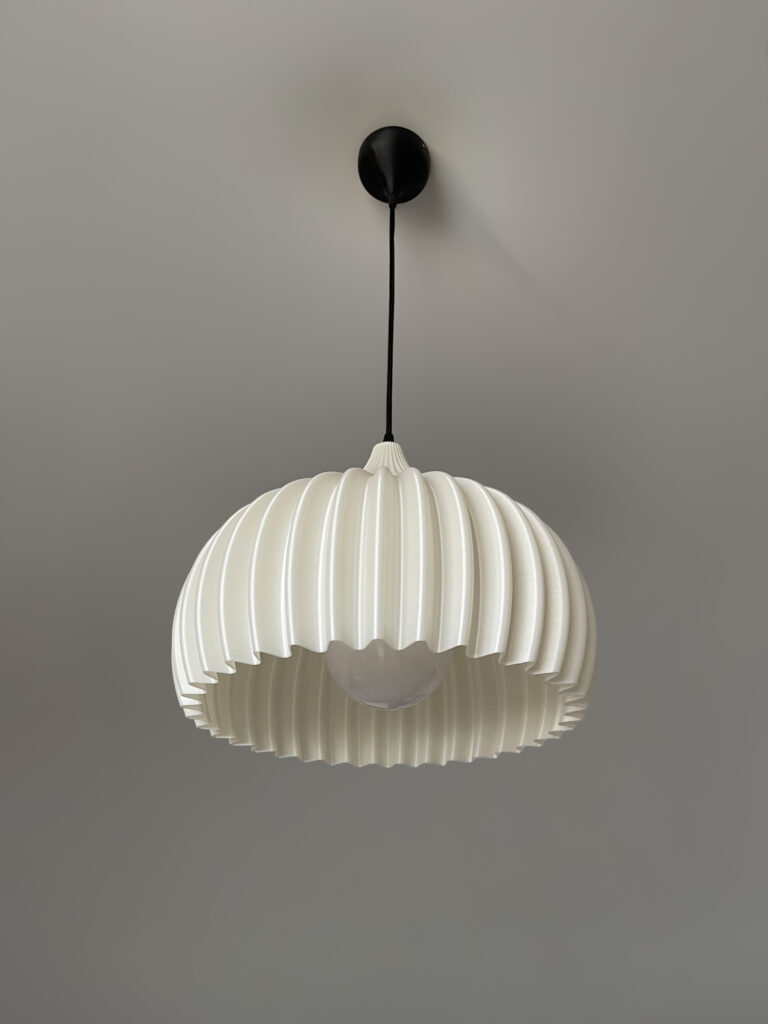
A G125 globe bulb paired with our LOKK lampshades – the proportions are just right.
Step 3 – Pick the right light colour (Kelvin)
Light has colour. You have probably noticed that some rooms feel warm and cosy while others feel bright and clinical – that is almost entirely down to the colour of the light bulb. This is measured in Kelvin (K). The lower the number, the warmer and more orange the light. The higher the number, the cooler and bluer it becomes.
Here are the three ranges you will encounter:
2700K – 3000K
Warm White
Soft, amber-toned light. Creates a cosy, relaxed atmosphere. Great for living rooms, bedrooms, and dining areas.
3500K – 4000K
Neutral White
Clean, balanced light – not too warm, not too cold. Works well in kitchens, home offices, and bathrooms.
5000K – 6500K
Cool / Daylight
Crisp, blue-white light that mimics daylight. Energising and focused – suited to workspaces and task lighting.
The colour temperature you choose also affects how your lampshade looks. Our shades are printed on three base colours – and each works best with a specific light temperature:
Pure White
Best with Neutral White (3500–4000K). Keeps the white crisp and clean – warm light can make white shades look slightly yellow.
Soft Ivory
Best with Warm White (2700–3000K). Enhances the gentle warmth of the ivory tone for a beautiful, layered glow.
Warm Amber
Best with Warm White (2700K). Deepens the amber richness and creates an incredibly cosy, golden atmosphere.
Step 4 – Do you want a dimmable bulb?
A dimmable LED lets you adjust the brightness from full power down to a gentle glow. This is wonderful for lampshades in living rooms or bedrooms where you want flexibility – bright when you need it, soft and atmospheric in the evenings.
There are two things to know before buying:
The bulb must say “dimmable”
Not all LED bulbs can dim – in fact, most basic ones cannot. A non-dimmable LED used with a dimmer switch will flicker, buzz, or fail early. Always check the box for the word “dimmable” before buying.
You also need a compatible dimmer
A standard on/off wall switch cannot dim anything. You need either a wall dimmer switch (wired in by an electrician) or a plug-in remote dimmer unit that sits between the wall socket and your lamp cord. Both work well.
Step 5 – Consider a smart bulb
Control brightness, colour, and schedules – all from your phone
Smart LED bulbs screw into your lamp exactly like any ordinary bulb, but they connect to your home Wi-Fi and are controlled through a free app on your smartphone. No separate dimmer switch needed, no rewiring – just screw in, download the app, and you are in control.
Adjustable brightness
Dim from 100% down to a barely-there glow, all from your phone. No dimmer switch or extra hardware needed.
Adjustable colour temperature
Switch between warm, neutral, and cool light at any time. One bulb covers every mood and situation.
Voice control
Works with Alexa, Google Home, and Siri. “Hey Google, dim the lamp to 40%” – and it just happens.
Schedules and scenes
Set the lamp to come on at sunset, dim automatically at bedtime, or create a “reading” scene at the tap of a button.
Smart globe bulbs in E27 fitting are available from these popular brands:
IKEA Trådfri
TP-Link Tapo
Govee
Sengled
Most are available in G95 or G125 globe shapes in E27 fitting – a perfect match for our lampshades. Prices start from around $10–15 for entry-level models.
Quick summary – what to look for on the box
Our kits – what socket comes with each?
Canopy kit with woven cable – E27 socket included
Our ceiling canopy kit comes with a fabric cable and an E27 bulb holder. Simply add a G120 or G125 dimmable LED in warm or neutral white – or go smart and skip the dimmer entirely. No bulb is included in the kit; pick one up at any hardware shop or online.
Plug-in cord with inline switch – E27 socket included
Our plug-in cord has a 1-metre fabric cable with a plug, an inline on/off switch, and an E27 bulb fitting. Plug it in, add your bulb, and you are done. For dimming without a wall switch, a plug-in remote dimmer unit or a smart bulb are both excellent options.